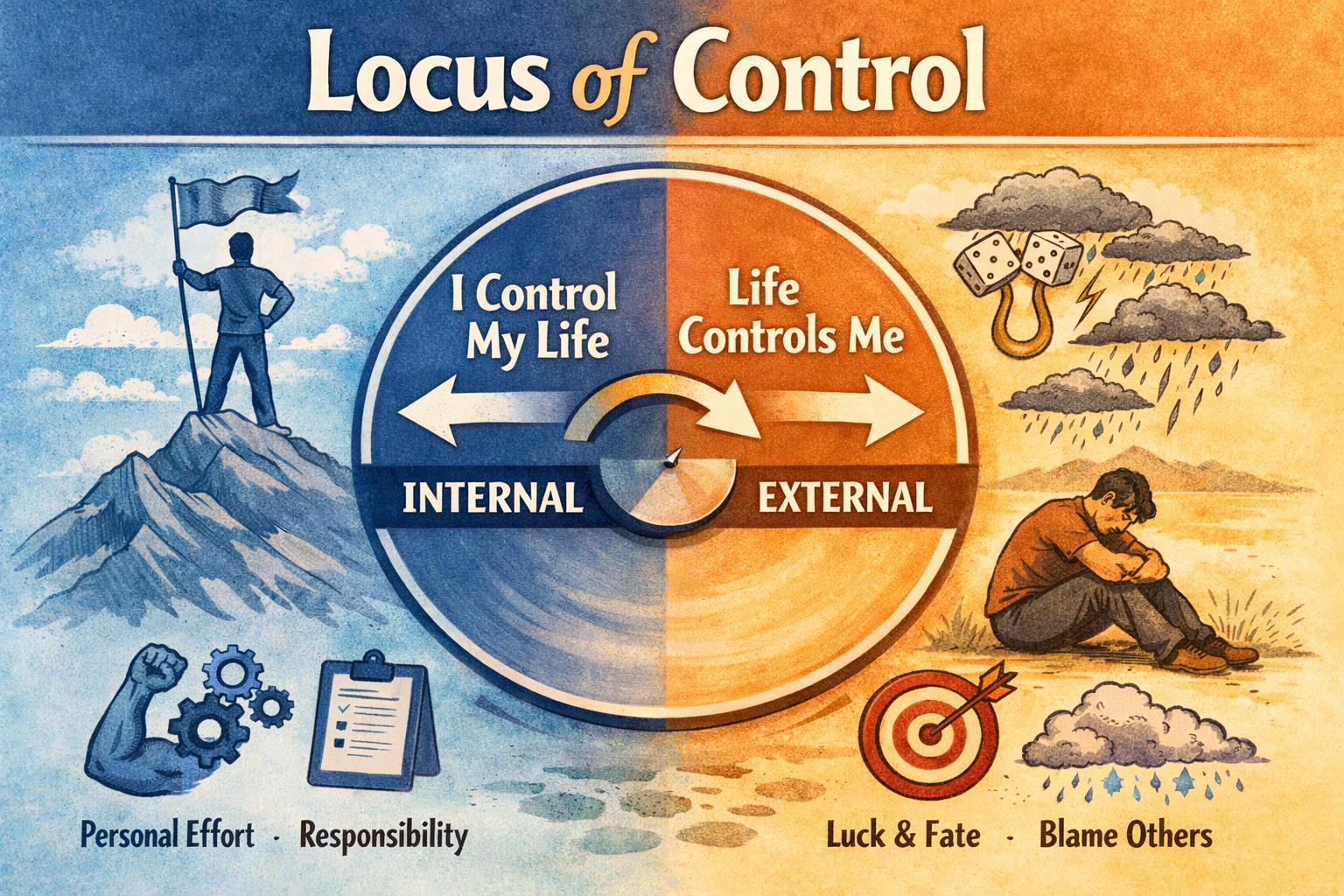
The Locus of control is about where you believe control over your life and work actually sits. The concept was coined way back in 1954 by Julian Rotter, when he was trying to understand a deceptively simple question – Why do people respond so differently to the same situation?
Carrot and Stick
Rotter challenged the dominant thinking of the time, which said behaviour was mainly driven by rewards and punishments. He believed that was only part of the picture. What mattered just as much was what people believed about cause and effect. You see, some people believe outcomes are shaped largely by their own actions. Others believe outcomes are driven by luck, systems, authority, or circumstances. That belief quietly drives their behaviour.
Internal locus of control
It sounds like this:
-
“What can I influence here?”
-
“What’s the best next decision with the information I have?”
-
“Where do I still have choice?”
External locus of control
While an external locus of control sounds more like this:
-
“There’s nothing I can do until someone else decides.”
-
“It’s pointless trying – the system won’t change.”
-
“That’s just how it is.”
This isn’t about optimism or denial. People with a strong internal locus don’t pretend they control everything. They’re realistic about constraints. The difference is that they take responsibility for the part they do control. And that matters because locus of control directly affects:
-
Motivation – effort feels worthwhile when it’s believed to matter
-
Resilience – setbacks become information, not proof of failure
-
Decision-making under pressure – ownership beats blame
-
Leadership behaviour – teams copy what leaders model
When things get tough……pressure rises, energy drops or the path ahead isn’t clear – and then you see people’s true locus of control. Leaders who keep saying “there’s nothing we can do” teach their teams to wait, withdraw and give up responsibility. Leaders who stay calm and focus on what can be influenced teach their teams to take ownership, make decisions and keep moving.
High performing teams
High-performing teams focus their energy on the 10–20% they can influence, rather than burning it on the 80% they can’t. Over time, that mindset becomes culture – not the one written on the wall, but the one people actually experience. 72 years later and Rotter’s insight still appears to hold true in 2026:
People don’t just react to reality. They react to what they believe they can influence.
You don’t need certainty to lead well. You need clarity about where control really sits and the courage to use it.
Pressure has a habit of revealing leadership gaps.
When energy dips or things feel uncertain, some leaders wait to be told what to do. Others take calm ownership, make good decisions and bring their teams with them. That difference isn’t personality. It’s skill.
Our Open Leadership Programme is designed for managers who want to lead well when it actually matters – under pressure, with limited information, and real people relying on them.
Over six months, participants build confidence in decision-making, clarity in how they lead others, practical tools they can use the next day (not theory) and stronger self-awareness and impact as a leader It’s not about being louder, tougher or having all the answers. It’s about knowing what you can control, taking responsibility for it, and helping others do the same.
If you have managers who are capable, committed, and ready to step up – this programme gives them the structure, support and challenge to do exactly that.
Places are limited. If now feels like a leadership moment, it probably is.